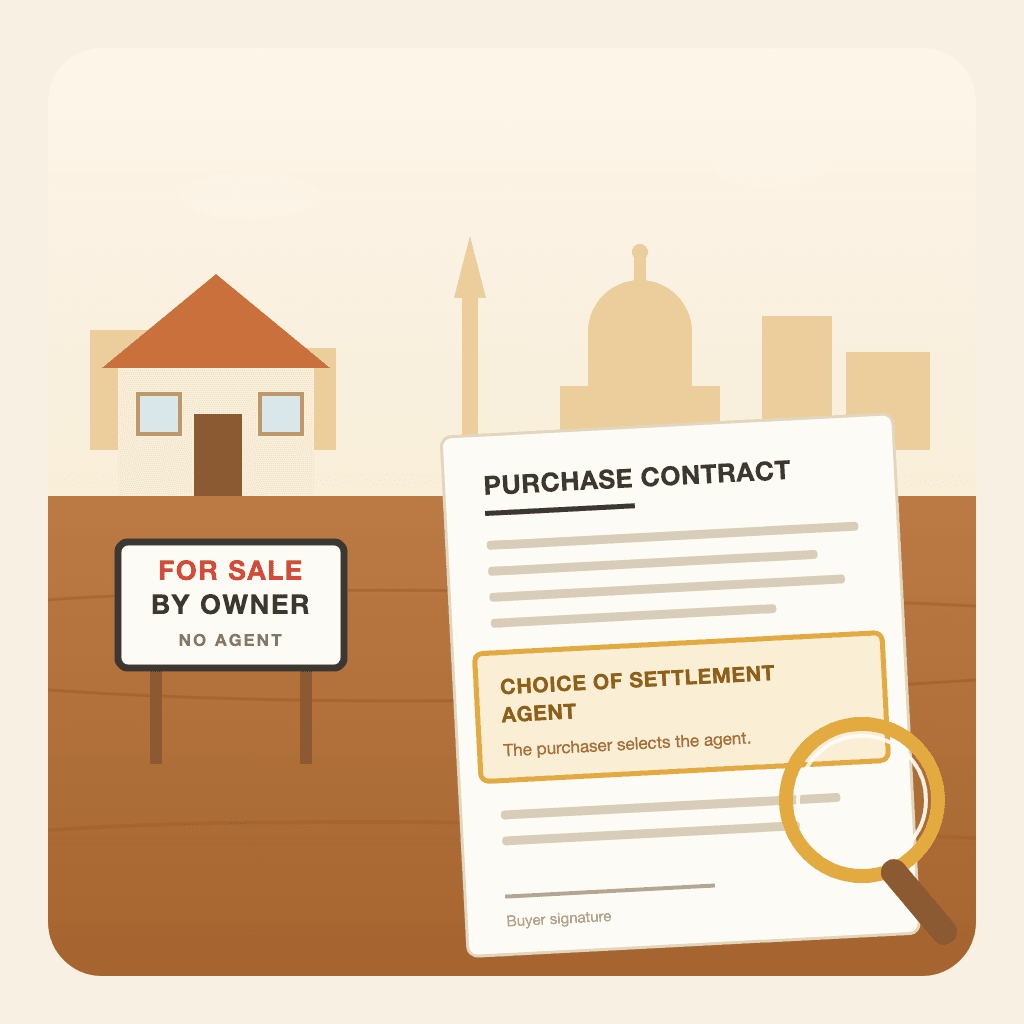

Buying directly from the owner in Northern Virginia? Virginia law gives you the right to choose the settlement agent, and your FSBO contract may not say so. What to order, and when.
Planning a closing?
Get a local title quote for Virginia, Maryland, or Washington DC.
Get a Title Quote →Buying directly from the owner in Northern Virginia — FSBO, a private home purchase, a neighbor, a family member — removes the agent from the middle of the deal. That saves commission. It also removes the person who, in a normal transaction, quietly handles about a dozen things you have probably never had to think about.
Most of those things land on the title and settlement side. Here is what changes when nobody is doing them for you, and what you should do about it.
The short answer
Yes, you should buy an owner's title insurance policy, and you get to pick who issues it.
Virginia does not require an owner's policy. If you are financing, your lender will require its own policy — but that one protects the lender, not you. The State Corporation Commission, which regulates title insurance in Virginia, puts it plainly: the lender's policy "protects the lender's security interest," while the owner's policy protects you and "remains in effect as long as you or your heirs have an ownership in the property."
On who chooses, the SCC is equally blunt: "Who Chooses the Title Insurance Company? You do."
The right your FSBO contract may not tell you about
Virginia law gives the buyer the right to choose the settlement agent. Not the seller, not the seller's attorney, not whoever the seller used last time:
"A purchaser or borrower in a transaction related to real estate in the Commonwealth shall have the right to select the settlement agent to provide escrow, closing, or settlement services in connection with the transaction. The seller in such a transaction may not require the use of a particular settlement agent as a condition of the sale of the property."
— Va. Code § 55.1-1006
Here is the part that matters specifically in a FSBO deal. Virginia also requires that contract to tell you about this right. Va. Code § 55.1-1007 says every contract to purchase real estate "containing not more than four residential dwelling units" must include, "in at least 10-point boldface type," a Choice of Settlement Agent notice spelling out that the purchaser selects the settlement agent.
When you buy through agents, that language is already baked into the standard contract forms. When a seller writes their own contract, or downloads a template, or hands you a two-page bill of sale their cousin used in 2019, that disclosure is frequently missing.
If the notice is not in your contract, you still have the right. The obligation is on the contract to disclose it, not on you to discover it. Read your contract, and if that boldface paragraph is not there, treat it as a signal about how the rest of the paperwork was prepared.
What the agent used to do that nobody is doing now
In an agented transaction, somebody is quietly running a checklist. Without one, these are the items that most often slip:
- Ordering title work early enough. A title search turns up liens, judgments, unpaid property taxes, old mortgages never released, boundary and easement issues. Finding those in week one is an inconvenience. Finding them three days before closing is a crisis.
- Chasing the payoff. Somebody has to request the seller's mortgage payoff statement and confirm the existing loan actually gets released.
- HOA and condo resale documents. In most of Northern Virginia this is not optional paperwork, and the association controls the timeline. Nobody is going to start it for you.
- Coordinating the lender. Your lender will instruct the settlement agent on signing, recording, and disbursement. Someone has to keep those two talking.
- Watching the contract dates. Inspection, financing, and settlement deadlines do not enforce themselves.
None of this is exotic. It is simply unowned when there is no agent, and "unowned" is how closings fall apart.
The fraud risk that is genuinely higher in a private sale
Virginia imposes a specific duty on your settlement agent:
"Prior to settlement, the settlement agent shall exercise ordinary care to reasonably ascertain the identity of a seller of real property."
— Va. Code § 55.1-903
The statute goes on to list acceptable methods — satisfactory evidence of identity, multiple forms of photo ID, a written statement from the seller's attorney, reviewing land records.
That duty exists because seller impersonation is real. Someone identifies a property with an absentee or out-of-state owner, poses as that owner, and tries to sell a house they do not own. In an agented sale, a listing agent has met the seller and a brokerage has done some verification. In a private sale where you found the property yourself, that layer is simply absent — and the whole transaction can rest on a settlement agent doing this step properly.
Ask directly how your settlement agent verifies seller identity. A good one will have an immediate answer.
A discount almost nobody claims in a FSBO deal
This one is worth real money and it is routinely missed.
The SCC guide notes that on a new purchase, you may be entitled to a "reissue credit" on your title insurance premium "if your seller purchased an owner's title insurance policy, no matter what company issued the prior policy." The catch: "The seller may have to produce the policy so that the credit may be accurately calculated by your title agent."
In an agented sale, someone thinks to ask. In a FSBO deal, usually nobody does — and the buyer pays full premium on a discount they qualified for.
Ask the seller, early and in writing, whether they have their owner's title insurance policy from when they bought. If they do, get a copy to your title agent. If they cannot find it, the title company they used may still have it.
Who pays for it
There is no law assigning this. The SCC again: "Local practice, not the law, determines who pays the premium. This can be a negotiation point between the seller and the buyer."
In a FSBO deal there is no agent steering you toward "how it's normally done," which cuts both ways. It is genuinely negotiable — so negotiate it, and put the answer in the contract rather than discovering it on the settlement statement.
Shop the whole number, not the premium
Title insurance rates in Virginia are not fixed by the state. Companies "establish their own rates and can negotiate the rate with any potential insured."
That means comparing quotes is worth your time — but compare the whole stack, not just the premium. The SCC's own list of what else to ask about: the title search, title examination, title commitment preparation, settlement fees, release fees, notary fees, courier fees, and document preparation fees.
A low premium next to a padded fee column is not a deal. Ask for the total, itemized, in writing.
If you want to sanity-check the rest of your closing numbers first, the Virginia closing cost calculator will get you in the right neighborhood.
What to do, in order
- Read your contract for the Choice of Settlement Agent paragraph. If it is missing, you still have the right — and now you know something about the contract.
- Pick your settlement agent yourself, early. Before you need them, not after a problem appears.
- Order title work immediately. The whole point is time to fix what it finds.
- Ask the seller for their old owner's policy and pass it to your title agent for the reissue credit.
- Ask how seller identity gets verified. Listen for a specific answer.
- Start HOA or condo resale documents now if the property is in an association.
- Get an itemized quote, not a premium number.
- Buy the owner's policy. It is optional, one premium, and it is the only policy in the deal that protects you.
Talk it through
Buying without an agent is very doable. It goes wrong when the title side goes unowned until the last week.
Will Rapuano handles title and settlement in Northern Virginia with Pruitt Title. If you have a private-sale contract and want a straight answer about what to order and when — or an itemized quote to compare against another one — get in touch.
This page explains how title insurance and settlement work in Virginia. It is general information, not legal advice about your transaction.
Frequently Asked Questions
Do I need title insurance if I'm buying for sale by owner in Northern Virginia?
An owner's policy is not required by Virginia law, and it is not required by the fact that you are buying FSBO. If you are financing, your lender will require a lender's policy, which protects the lender only. The owner's policy is the one that protects you, and it covers title problems that already existed before you bought — which a private sale does nothing to reduce.
Can the seller make me use their title company?
No. Va. Code § 55.1-1006 states the seller "may not require the use of a particular settlement agent as a condition of the sale of the property." A seller may retain their own attorney to represent their interests, which is a different thing from choosing your settlement agent for you.
How do I get title insurance in Northern Virginia if there's no agent involved?
You contact a settlement agent or title company directly and tell them you have a ratified contract. You do not need a real estate agent to order title work, and a title company for a direct home purchase from the owner works exactly the same way it would in an agented sale.
Does a private home purchase make title problems more likely?
The title itself carries whatever it carried before — liens, unreleased mortgages, easements, heirs, and recording errors do not care how the buyer found the house. What changes is that fewer people are looking. That makes the title search more important, not less, and it raises the value of starting it early.
I'm buying from out of state. Does that change anything?
The title work is the same. The logistics are not — you will want to settle remote-signing, document delivery, and wire instructions well before settlement day rather than in the final week.
Is an attorney required for a Virginia closing?
No. Virginia permits non-attorney settlement agents, and a settlement agent who is not your attorney cannot give you legal advice. If you want legal advice about your contract or your interests, that is a separate engagement with a Virginia attorney.
Ready to Get a Title Quote?
Send your transaction details through DMV Title Guy. Will can answer initial questions and, when eligible, refer the request to Pruitt Title LLC for review.