
Planning a closing?
Get a local title quote for Virginia, Maryland, or Washington DC.
Get a Title Quote →Most buyers don't think about title insurance until they're sitting at the closing table staring at a line item on their settlement statement. By then, the decision has usually already been made for them. That's a problem — because not all owner's title insurance is the same, and the difference between standard and extended coverage can matter significantly depending on the property you're buying.
Here's what you actually need to know.
Two Types of Owner's Title Insurance
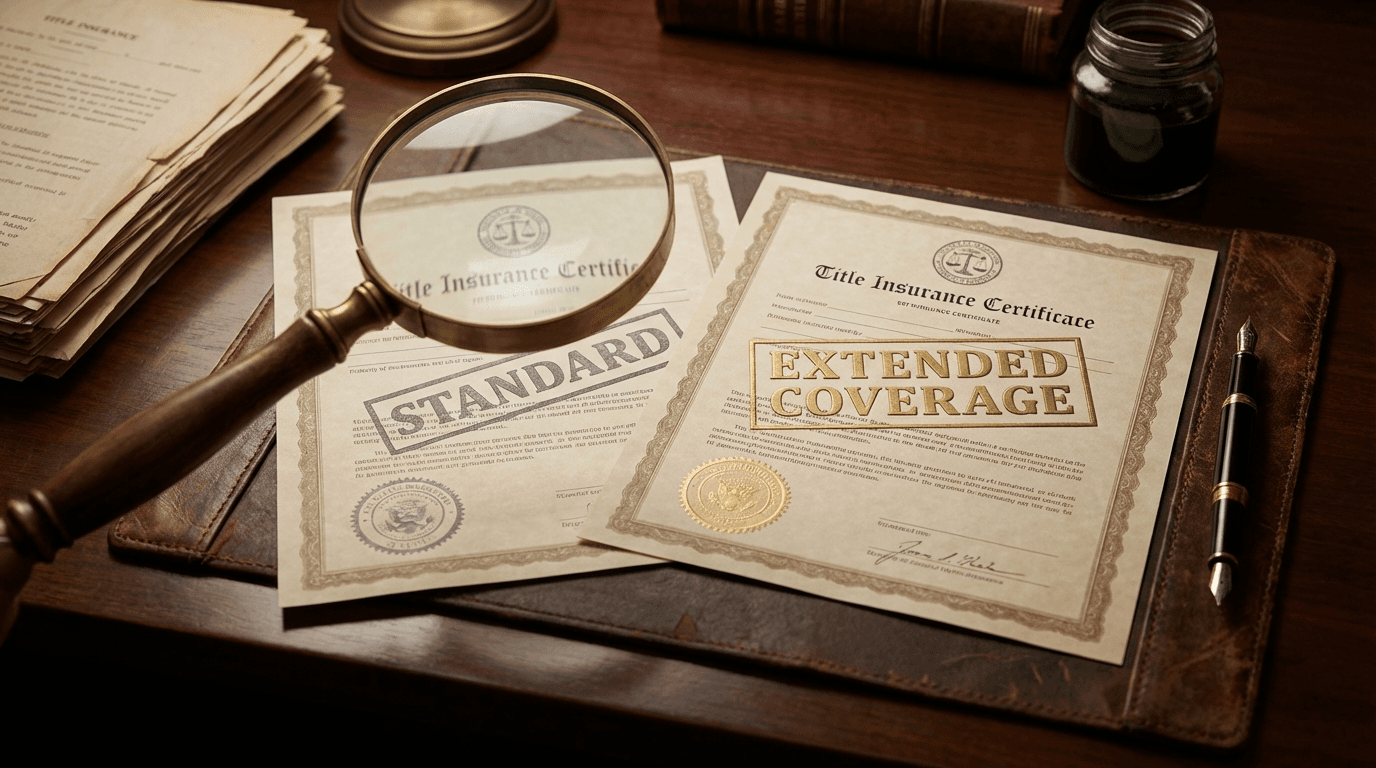
When you buy a home in Virginia, Maryland, or DC, you'll typically be offered owner's title insurance at closing. What most buyers don't realize is that there are two levels of coverage:
Standard (or Basic) Coverage — protects against defects in the chain of title that existed "before" you closed. Think forged signatures on past deeds, undisclosed heirs, clerical errors in public records, or fraud that happened before you ever came into the picture.
Extended (Enhanced) Coverage — does everything standard does, plus protects against certain post-closing risks. This is also called an ALTA Homeowner's Policy, and it's the version that's worth understanding in detail.
What Standard Coverage Protects Against
Standard title insurance is tied to the historical record. If someone shows up after closing claiming they have a rightful interest in your property based on something that happened before you bought it, standard coverage has your back. Specifically, it covers:
- Forged deeds or documents in your chain of title
- Fraud by prior owners or their representatives
- Errors in the public record (wrong legal description, incorrect name on a deed)
- Undisclosed heirs who have a legal claim to the property
- Liens that weren't discovered during the title search
That's solid protection. But it stops at the closing date.
What Extended (Enhanced) Coverage Adds
Extended coverage — the ALTA Homeowner's Policy — goes further. It protects against risks that can emerge "after" you close, including scenarios that wouldn't have shown up in even the most thorough title search. Here's what's added:
Post-closing forgery. If someone records a fraudulent deed or other document against your property after you've already purchased it, extended coverage applies.
Encroachments discovered later. Say your fence turns out to be six inches over the property line. Or your neighbor's shed has been sitting on your land for years without anyone noticing. Extended coverage can cover the cost of resolving it.
Building permit issues. If a previous owner did unpermitted work on the home, extended coverage can protect you from certain compliance costs that surface later.
Subdivision plat issues. If there's a problem with how the lot was subdivided that affects your ability to use the property the way you intended, extended coverage may apply.
Coverage inflation adjustment. Some ALTA Homeowner's Policies include an automatic inflation adjustment — meaning your coverage increases over time as your property value grows.
Forced removal of existing structures. If a government authority requires removal of a structure because it violates a law or regulation that existed before your purchase, extended coverage can protect you.
The Cost Difference
Extended coverage costs more than standard — typically 10-30% above the standard premium. In Virginia, title insurance rates are filed with the State Corporation Commission, so you won't see huge variation from company to company. On a $600,000 home, you might pay $1,400 for standard coverage and $1,600-$1,700 for extended.
That extra $200-$300 is a one-time cost. There are no renewal premiums. The policy covers you for as long as you own the property.
When Extended Coverage Matters Most
Not every buyer needs extended coverage equally. Here's how to think about it:
New construction: If you're buying a brand-new home from a builder, extended coverage is especially worth considering. There's often less title history to search, but there can be more exposure to post-closing risks like boundary disputes, permitting issues, or easements that weren't fully disclosed.
Older homes with long ownership histories: Properties that have changed hands many times — especially in older neighborhoods — can have cleaner title histories (lots of prior searches) but extended coverage still adds a layer of protection for post-closing risks.
Properties with known quirks: If the seller disclosed any boundary disputes, fence disagreements, or renovation work that may not have been fully permitted, extended coverage is a smart add.
Land and lot purchases: Raw land transactions can be particularly complex when it comes to easements, access rights, and subdivision issues. Extended coverage is worth the conversation.
What Neither Policy Covers
Before you pick a coverage level, understand what title insurance doesn't cover regardless of which type you choose:
- Known defects you were told about at closing (if it's disclosed, it's excluded)
- Eminent domain — if the government takes your property, title insurance doesn't pay out
- Environmental issues like contamination or hazardous materials
- Zoning or land use restrictions (though extended coverage handles some related scenarios)
- Defects you created after you bought the property
Title insurance is not the same as homeowner's insurance. Your homeowner's policy covers physical damage — fire, wind, theft. Title insurance covers legal ownership — your right to actually own and possess the property.
The Decision You Actually Need to Make
In practice, some Virginia closings default to extended/ALTA coverage — some lenders, title companies, and real estate attorneys routinely recommend it as a matter of course. Others offer standard coverage and let the buyer upgrade if they choose.
The right answer depends on:
1. The property. New construction and properties with complicated histories benefit more from extended coverage.
2. The cost. The premium difference is relatively modest compared to your overall transaction. On a $500,000 home, we're talking a few hundred dollars of additional protection that lasts as long as you own the property.
3. Your risk tolerance. If a post-closing boundary dispute or building permit issue would be a significant financial or logistical problem for you, extended coverage is worth it.
At closing, ask your title company which type of owner's policy they're issuing. If it's standard, ask what the upgrade to extended (ALTA Homeowner's Policy) would cost. Make an informed choice — don't just sign whatever's in front of you.
Working with a Local Title Company Who Explains It
Closing day moves fast, and title insurance coverage decisions often get less attention than they deserve. A good title company — one that takes the time to explain coverage differences, answer questions, and make sure you leave fully informed — is worth more than a small rate difference between competitors.
At EKKO Title, a selected title provider may explain the difference between standard and extended coverage at every closing. We're not in the business of upselling you on coverage you don't need. We're in the business of making sure you understand what you're buying and why.
If you have questions about title insurance coverage for your upcoming purchase in Northern Virginia, Maryland, or DC, reach out to us directly. We'll give you a straight answer.
EKKO Title serves homebuyers throughout Northern Virginia, Washington DC, and Maryland. Questions about your title insurance options? Contact us today.
Try our Virginia closing cost calculator before you make an offer.
Ready to Get a Title Quote?
Send your transaction details through DMV Title Guy. Will can answer initial questions and, when eligible, refer the request to Pruitt Title LLC for review.