
Planning a closing?
Get a local title quote for Virginia, Maryland, or Washington DC.
Get a Title Quote →Here's a question I get at almost every closing table: "Wait, what's the difference between homeowners insurance and title insurance? Don't they both protect my house?"
They don't — at least not in the same way.
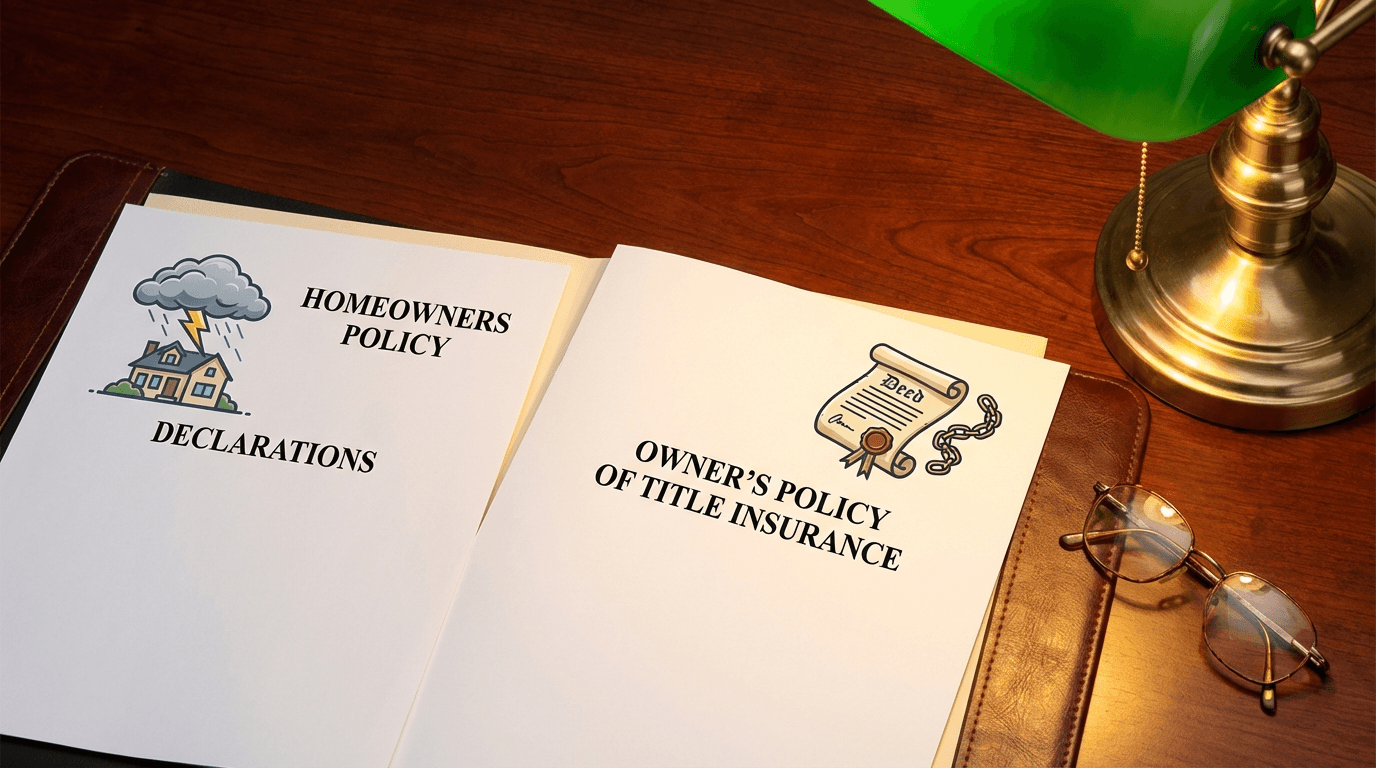
Homeowners insurance protects you from what might happen in the future. Title insurance protects you from what already happened in the past.
That one sentence is the whole thing. But if you're buying a home in Virginia, Maryland, or DC, understanding the nuance between these two policies matters — because you're going to need both, and they're protecting you against two completely different sets of risks.
What Homeowners Insurance Actually Covers
Homeowners insurance is the one most people know. Your lender requires it. You pay a premium every year. If the house burns down, floods, or someone trips on your front steps and sues you, homeowners insurance steps in.
The key feature: it covers things that happen after you take ownership.
Standard homeowners insurance typically covers:
- Fire and smoke damage
- Wind, hail, and storm damage
- Theft and vandalism
- Personal liability (someone gets hurt on your property)
- Additional living expenses if you can't live in the home while it's repaired
What it doesn't cover: flooding (that's a separate policy), earthquake damage (usually a rider), and anything related to who actually owns the property.
Your homeowners premium renews every year. The protection runs as long as you keep paying. If you stop, you're unprotected.
What Title Insurance Actually Covers
Title insurance is different in almost every way.
First, you pay for it once — at closing. There's no annual premium, no renewal. You buy the policy and it protects you for as long as you own the home (and in some cases, your heirs after you).
Second, it's not forward-looking. It doesn't care about tomorrow's storm or next year's fire. It's protecting you from title defects that existed before you ever signed a contract.
Here's what that means in practice.
When your title company conducts a title search before closing, they're looking for problems in the chain of ownership going back decades. Most of the time, the title is clean. But "most of the time" isn't all the time — and title insurance is the safety net for when the search misses something, or when an issue appears that no search could have uncovered.
Title insurance covers claims like:
- Forged documents — a previous deed was signed fraudulently, and a prior owner's heir shows up with a claim
- Undisclosed heirs — a deceased owner had a child no one knew about, who now has a legal claim to the property
- Unpaid liens — a contractor filed a mechanics lien in the gap between the title search and your closing date, or a prior lien wasn't paid off at an old closing
- Boundary and survey errors — a survey was filed incorrectly and a neighbor claims part of your yard
- Errors in public records — a clerk recorded a document incorrectly, and now there's a defect in the title chain
- Zoning violations from prior owners — a previous owner built something without a permit, and the municipality is now coming after the property
These aren't hypothetical. Title companies deal with these situations regularly. The dollar amounts can be significant — we're talking about a cloud on the ownership of an asset worth hundreds of thousands of dollars.
Two Policies at Closing: Lender's vs. Owner's
When you close on a home with a mortgage, you'll almost always see two title insurance policies on your settlement statement:
Lender's Title Insurance — this is required by your mortgage lender. It protects the bank's interest in the property. If a title defect surfaces and someone challenges ownership, the lender needs to know their collateral is protected. You pay for this policy at closing, but it only protects the lender — not you.
Owner's Title Insurance — this is optional (though strongly recommended). It protects "your" equity in the property. If that same title defect surfaces and someone claims ownership, the owner's policy defends your interest, pays legal costs, and compensates you if you lose.
The lender's policy is typically required. The owner's policy is the one that actually protects you.
In Virginia, Maryland, and DC, the insurance premium itself is set by the underwriter's filed rates with the state — the title company doesn't set it, so shopping around won't change what you pay for the policy. What does vary between title companies: settlement fees, title search charges, and other service line items. What also varies is the quality of the search, the competence of the team, and the underwriter's financial strength.
Side-by-Side: Homeowners vs. Title Insurance
| Homeowners Insurance | Title Insurance | |
|---|---|---|
| What it covers | Future damage and liability | Past title defects |
| When you pay | Annual premium | One-time at closing |
| How long it lasts | As long as you pay | As long as you own the home |
| Required by lender | Yes | Lender's policy: yes |
| Protects you personally | Yes | Owner's policy: yes |
| Covers storms, fire, theft | Yes | No |
| Covers ownership disputes | No | Yes |
Is homeowners insurance the same as title insurance?
No. Homeowners insurance covers future physical damage and liability to your home. Title insurance covers ownership disputes and title defects that originated before you purchased the property. You need both — they protect against completely different risks.
Do I need title insurance if I'm paying cash?
You don't need a lender's title policy (since there's no lender), but an owner's title policy is still a smart buy. Without a mortgage, you have no secondary protection if a title defect surfaces after closing.
Who pays for title insurance in Virginia?
In Virginia, it varies by transaction and negotiation. In Northern Virginia, it's common for the buyer to pay for both the lender's and owner's policy, though in some markets and new construction contracts, the seller pays for the owner's policy. Your settlement statement will itemize who's paying what.
Does title insurance cover me forever?
Your owner's title insurance policy covers you for as long as you own the property — and in some cases, extends to your heirs after you. There's no annual renewal required.
How much does owner's title insurance cost in Virginia?
Owner's title insurance is typically a one-time premium calculated as a percentage of the purchase price, based on filed rates with the state. For a $600,000 home in Virginia, you might pay roughly $1,500–$2,200 for the owner's policy, though exact costs depend on the purchase price, underwriter, and whether a simultaneous issue discount applies. Use our title quote calculator for an accurate estimate.
Can title insurance be cancelled?
Owner's title insurance cannot be cancelled — it runs for the life of your ownership. Homeowners insurance, by contrast, can be cancelled or modified at any time.
Ready to Get a Title Quote?
Send your transaction details through DMV Title Guy. Will can answer initial questions and, when eligible, refer the request to Pruitt Title LLC for review.