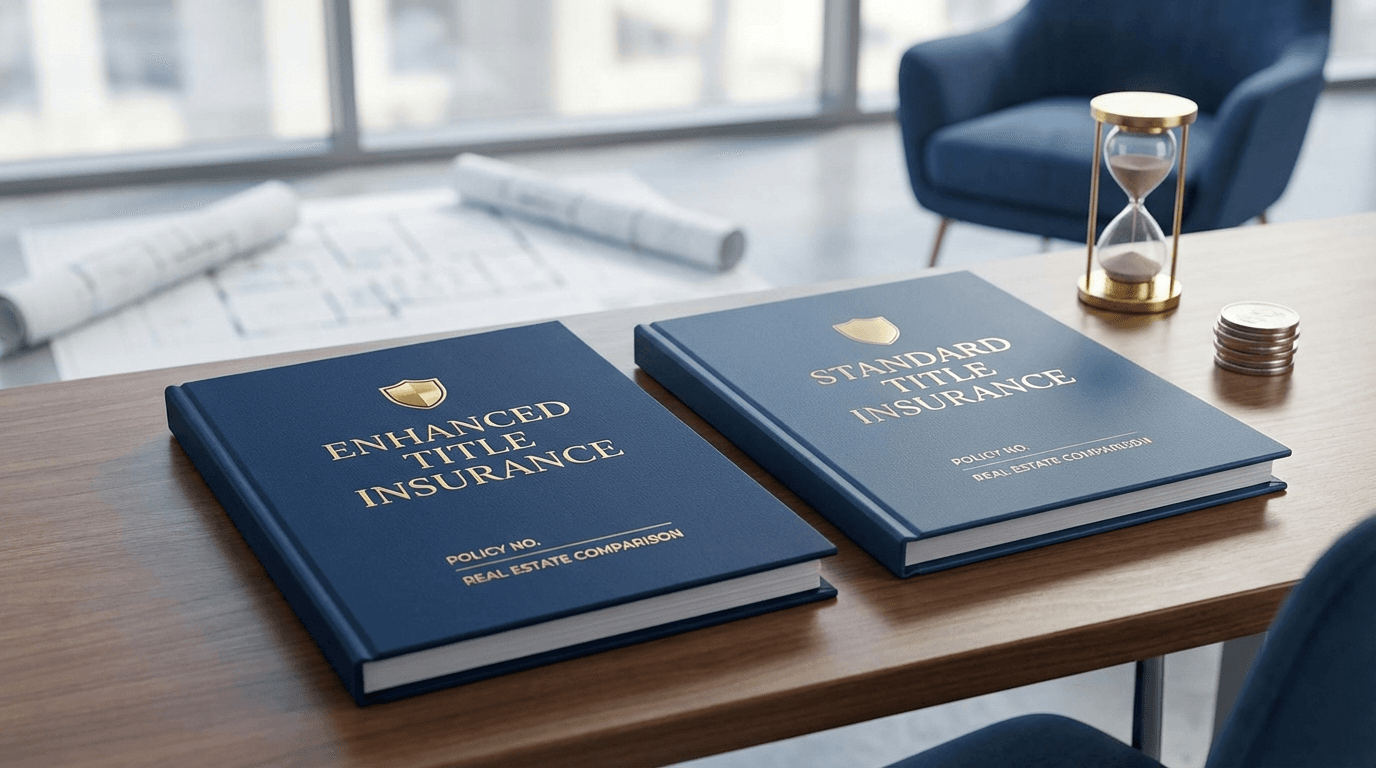

Enhanced title insurance costs a little more than standard coverage — but what does it actually add? Here's the honest comparison for buyers in Virginia, Maryland, and DC.
Planning a closing?
Get a local title quote for Virginia, Maryland, or Washington DC.
Get a Title Quote →When a buyer is sitting at the closing table and someone mentions "enhanced" versus "standard" title insurance, the most common response is a polite nod followed by whatever the agent recommended three weeks ago. Most people accept the default and move on.
That's not necessarily wrong — but it helps to understand what you're actually getting for the extra cost, and whether your specific situation makes the upgrade genuinely useful or mostly irrelevant.
Here's the straight version.
The Short Answer
Standard title insurance protects you against problems that already existed in your property's history before you closed — things the title search might have missed, or things that couldn't be found in public records at all.
Enhanced title insurance (also called an ALTA Homeowner's Policy) covers everything standard covers, plus a defined list of risks that can emerge after you close — things that have nothing to do with the prior owners and everything to do with what happens once the property is yours.
The premium difference in the DMV is usually modest: somewhere in the range of $150 to $400 more at closing depending on purchase price. On a $700,000 home, that's a rounding error in the context of total closing costs. On a $300,000 condo, it's still worth understanding before you pay it.
What Standard Coverage Actually Does
Standard title insurance — sometimes called a basic owner's policy — is backward-looking. It protects against defects in your chain of title: problems that existed before you ever entered the picture.
The categories it covers include:
- Forged or fraudulent documents in the prior history of the property (a deed signed with a fake signature decades ago, for instance)
- Undisclosed heirs who show up after closing claiming rightful ownership based on an estate that was never properly resolved
- Errors in public records — incorrect legal descriptions, names transcribed wrong, recording mistakes that quietly clouded the title
- Unknown liens — a contractor who placed a mechanics' lien that never got cleared, a judgment creditor who attached the property before the sale
- Missing or improperly released mortgages from prior owners that didn't get fully discharged
This is real protection. Title searches are thorough, but they aren't perfect. Records go back decades. Estates get complicated. Clerical errors happen. Standard coverage is your backstop against the stuff that couldn't be fully verified.
What it doesn't cover is anything that happens after your closing date.
What Enhanced Coverage Adds
The ALTA Homeowner's Policy extends coverage forward in time — protecting against a specific list of post-closing risks. The exact list varies by underwriter, but in the DMV the most commonly covered additions include:
Building permit violations from prior owners. If the previous owner added a deck, finished a basement, or converted a garage without pulling permits, you can face costly remediation orders. Enhanced policies typically cover the cost of bringing those improvements into compliance or removing them.
Zoning and land use violations. If the existing structure turns out to violate current zoning — setback requirements, use restrictions, density rules — enhanced coverage can protect you from forced changes.
Boundary and survey discrepancies. Standard coverage protects against deed errors. Enhanced coverage goes further, covering situations where the actual physical boundaries differ from what the survey shows, or where encroachments are discovered after closing.
Automatic inflation coverage. Enhanced policies typically include an inflation rider that adjusts your coverage amount upward each year for the first five to ten years, keeping pace with appreciation. Standard policies have a fixed coverage amount that doesn't move.
Access and easement issues. If your property turns out to have access issues — a claimed right-of-way that doesn't legally exist, or an easement that blocks a use you expected — enhanced coverage often applies.
Post-closing forgery. If someone records a fraudulent deed or lien against your property after you close, enhanced coverage protects you. Standard coverage does not.
When Enhanced Coverage Makes the Most Sense
The upgrade is genuinely worth thinking about in these situations:
Older homes with complex histories. A 1940s bungalow in Bethesda has decades of transfers, estate sales, and potential permit-era confusion. The longer the chain, the more ways something can go wrong — including things that don't appear until after closing.
Properties with improvements. If the sellers added a sunroom, a finished basement, or any structure that wasn't in the original build, permit status becomes a real question. Enhanced coverage is your insurance against discovering that addition was never properly permitted.
Properties near boundary disputes. If your survey shows anything close to a neighbor's line, or if the listing disclosed any kind of encroachment issue, enhanced coverage addresses exactly this risk.
First-time buyers with high leverage. If you're putting down less than 20 percent and your equity cushion is thin, the last thing you need is an unexpected title defect that costs you $10,000 to resolve. Enhanced coverage is a relatively cheap way to sleep better.
Long-term hold. If you're planning to stay for fifteen years, the inflation rider alone may be worth the premium. Standard coverage on a $600,000 home is still $600,000 of coverage in year twelve — while the home may be worth $900,000. Enhanced policies grow with you.
When Standard Coverage May Be Sufficient
Standard coverage is completely reasonable in these situations:
New construction. If you're buying a brand-new home from a builder, there's no prior ownership history to worry about. The title chain is short and clean. Standard coverage is usually adequate unless the lot itself has complicated history.
Condos in large developments. In a well-managed condo association with professional management and clear records, the post-closing risks that enhanced coverage addresses are significantly reduced. Standard may be all you need.
Short-term hold. If you're buying a property you expect to sell or refinance in three to five years, the inflation rider and post-closing protections are less relevant. The backward-looking protection of standard coverage may be all you need for a shorter window.
Price-sensitive situations. There are legitimate reasons to minimize closing costs. Standard coverage protects your ownership interest against the most common title defects. If budget is a real constraint, standard isn't a bad policy — it just has a defined ceiling on what it protects.
What Pruitt Title Recommends
Pruitt Title writes both standard and enhanced policies for buyers across Virginia, Maryland, and DC — and we don't have a one-size-fits-all answer.
What we do have is a conversation. Every buyer's situation is different: age of the property, complexity of the title history, purchase price, how long you're planning to hold. The difference between standard and enhanced is modest enough that for most buyers, the enhanced upgrade makes sense — but we'd rather explain the trade-off and let you decide than push a default.
If you're under contract and want to talk through which policy fits your situation, contact us before your closing date. It's easier to make this decision before you're at the table than during it.
How much does enhanced title insurance cost compared to standard?
In the DMV, the premium difference is typically $150–$400 depending on the purchase price and underwriter. It's calculated as a percentage of coverage, so higher-priced properties pay a proportionally larger premium — but the percentage difference between standard and enhanced is usually small.
Is enhanced title insurance required?
No. Your lender requires lender's title insurance (which is separate and protects only the bank). Owner's title insurance — whether standard or enhanced — is always optional for the buyer. Most experienced buyers get it. Whether you choose standard or enhanced is your call.
Does enhanced title insurance cover everything?
No. ALTA Homeowner's Policies cover a defined list of risks. Environmental contamination, value loss due to market conditions, and issues you were aware of before closing are typically excluded. Your title professional can walk you through exactly what your policy covers.
Can I upgrade from standard to enhanced after closing?
Generally, no. Title insurance is a one-time premium paid at closing, and the policy is issued at that time. Upgrades after closing aren't typically available, which is why it's worth making this decision before you sign.
What's the difference between an enhanced owner's policy and a lender's policy?
A lender's policy (also called a mortgagee policy) protects your bank — not you. It's required if you're financing. An owner's policy protects your equity and your ownership interest. They're separate policies, and both are typically purchased at the same closing.
DMV Title Guy is the blog of Pruitt Title, a full-service title and settlement company serving buyers, sellers, agents, and lenders across Virginia, Maryland, and DC. Questions about your title policy options? Contact us → https://dmvtitleguy.io/contact before your closing date.
DMV title services: Vienna, VA | Springfield, VA | Bethesda, MD
Ready to Get a Title Quote?
Send your transaction details through DMV Title Guy. Will can answer initial questions and, when eligible, refer the request to Pruitt Title LLC for review.