
Planning a closing?
Get a local title quote for Virginia, Maryland, or Washington DC.
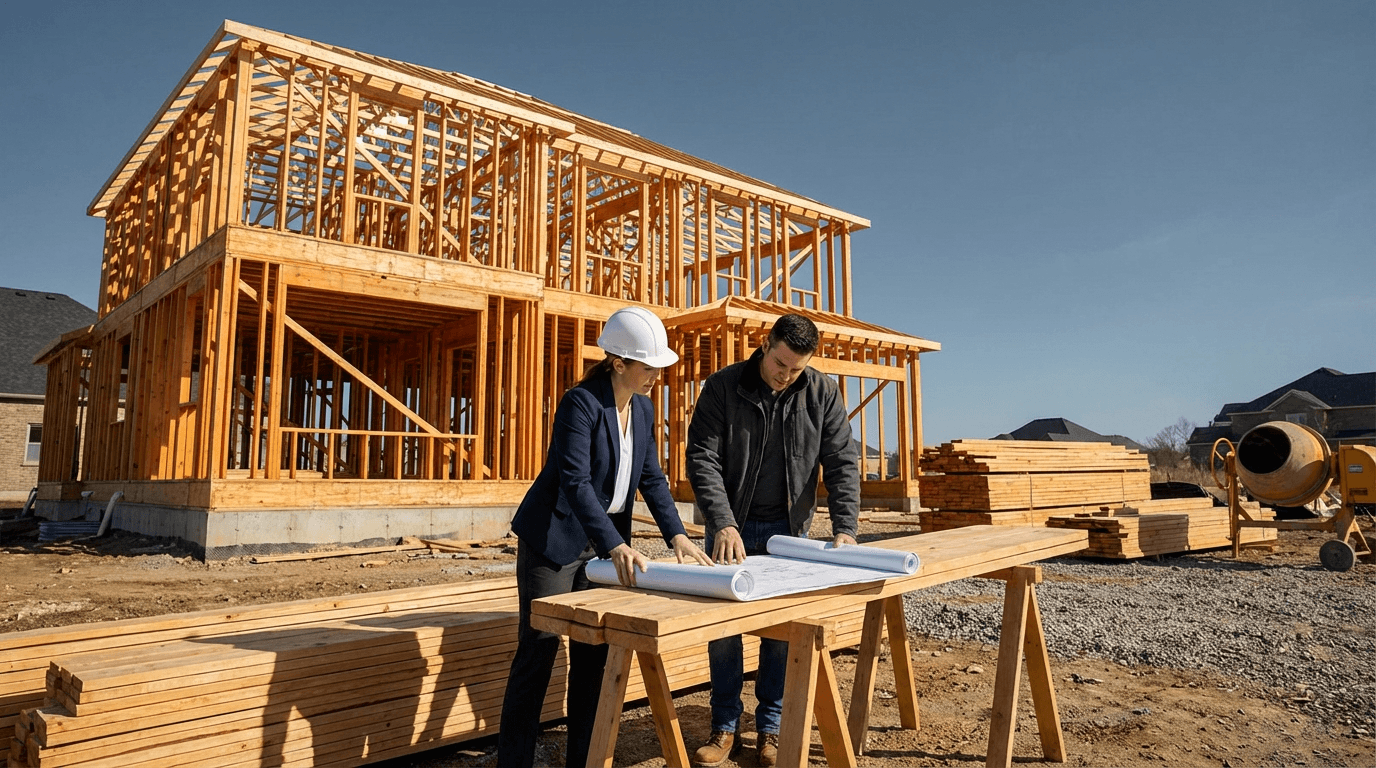
Get a Title Quote →Building a home in Maryland isn't the same as buying one. If you're planning a custom build in Montgomery County, a new construction project in Prince George's, or buying land in the outer DMV suburbs, you need to understand how construction loans work — before you break ground.
What Is a Construction Loan?
A construction loan is a short-term, higher-interest loan that funds building a residential property. Unlike a traditional mortgage that disburses a lump sum at closing, a construction loan releases funds in stages — called draws — as specific milestones are completed.
The lender doesn't write a blank check. They pay your framing crew when framing is done, your HVAC contractor when rough-in is complete, and so on. Before each draw, an inspector verifies the work meets spec.
Most construction loans run 12 to 18 months. They're interest-only during construction — you're paying only on what's been disbursed, not the full loan amount. Once construction wraps and the county issues a certificate of occupancy, the loan converts to a permanent mortgage or you close on new financing.
Two Types of Construction Loans
| Loan Type | How It Works | Closings Required | Best For |
|---|---|---|---|
| Construction-to-Permanent | Single loan converts automatically to mortgage at completion | 1 closing | Buyers who want rate certainty and cost savings |
| Stand-Alone Construction Loan | Separate short-term loan, refinanced into permanent mortgage at completion | 2 closings | Buyers with flexibility or uncertain permanent financing plans |
The construction-to-permanent option (sometimes called "one-time close") is the most common choice for owner-occupants building in Maryland. You lock your permanent rate upfront, pay one set of closing costs, and the loan flips to a 30-year (or 15-year) fixed at the end. The tradeoff: you're locking a rate potentially 12-18 months before you move in.
Stand-alone loans carry more flexibility but more cost — you'll pay closing costs twice and take rate risk at the permanent mortgage closing.
Maryland Requirements: What Lenders Expect
Construction loans are harder to get than traditional mortgages. Lenders are taking on more risk — they're financing something that doesn't exist yet — so they compensate with stricter underwriting.
Here's what most Maryland lenders require:
- Credit score: Minimum 680, with many lenders preferring 700+
- Down payment: At least 20% of total project cost (land + construction)
- Detailed plans and budget: Architectural drawings, specs, and a line-item construction budget before approval
- Signed builder contract: A fully executed, arm's-length contract with a licensed, lender-approved general contractor — the builder cannot be a family member in most loan programs
- Project timeline: Realistic build schedule with identified milestones
- Income documentation: Standard W-2s or tax returns; self-employed borrowers face the usual additional scrutiny
- Reserves: Some lenders require 6-12 months of mortgage payments in cash reserves
Montgomery County, Prince George's County, and the broader DC suburbs have high land costs, which means your total project budget — and thus your loan amount — can easily reach jumbo territory. Know your county's conforming loan limits before you start planning.
How Draws Work in Practice
Here's the typical draw sequence:
- Construction milestone is reached (e.g., foundation pour complete)
- Builder submits draw request to lender with documentation
- Lender orders an inspection to verify work meets specs
- Inspector signs off
- Lender releases funds — usually within 5-10 business days
- Funds disbursed to builder or held in escrow
Delays at any step create cash flow problems for builders and timeline pressure for buyers.
Why Title Insurance Works Differently on Construction Loans
This is the part most buyers and builders miss until they're in the middle of it.
On a standard purchase, title insurance is a one-time search and policy. On a construction loan, the title process is ongoing — because the risk profile changes every time a draw is disbursed.
Lender's Title Insurance: Required at Every Draw
Every Maryland lender will require a Lender's Title Insurance Policy. This protects the lender's security interest in the property against title defects, prior liens, and competing claims.
For construction loans specifically, lenders typically require a Construction Loan Update Endorsement (an ALTA endorsement) with each draw. It updates coverage to the new outstanding mortgage balance and confirms no new liens or encumbrances have been recorded since the last update. The lender needs to know their position is still first in line every time they release more money.
Owner's Title Insurance: Buy It at the Land Closing
If you're buying land before construction begins, buy owner's title insurance at that closing. Land can carry encumbrances — boundary disputes, easements, old liens, HOA restrictions — that may not surface in a quick title review. By the time you've poured a foundation, clearing a title problem becomes a major project.
Maryland law requires title companies to notify buyers in writing of their right to purchase an owner's policy. Don't waive it on raw land.
Mechanics' Liens: The Specific Risk in Construction
Mechanics' liens are the construction loan's hidden trap. In Maryland, contractors, subcontractors, and suppliers who provide labor or materials to your project have the right to file a lien against your property if they aren't paid — even if you paid your general contractor in full and the sub wasn't paid by the GC.
The standard protection is collecting lien waivers from every contractor and subcontractor involved in the project. Your title company should be managing this process at every draw. Before your lender converts the construction loan to a permanent mortgage, they'll typically require signed lien releases from all parties.
Work with a title company that has experience in construction closings. The draw management and lien waiver process is where things can go sideways fast if the settlement firm doesn't know what they're doing.
Maryland-Specific Programs Worth Knowing
Maryland Mortgage Program (MMP) — New Construction: Works with new construction for qualified borrowers, but homes must be in a designated Priority Funding Area. Most established DMV suburbs (Bethesda, Silver Spring, College Park, Rockville) qualify; exurban areas may not.
Net Zero Construction Loan Program: DHCD offers below-market-rate loans for homes built to a HERS rating of 50 or lower. If you're building a high-performance home, check this before committing to conventional financing.
County permit timelines: Montgomery and Prince George's counties have their own timelines, impact fees, and code requirements. Build these into your draw schedule — permit delays don't stop interest from accruing.
Common Mistakes Maryland Construction Borrowers Make
Underestimating the budget. Lenders typically won't increase a construction loan mid-project. Build in a 10-15% contingency — if you run short, you're covering the difference in cash.
Not vetting the builder. Your lender will vet the contractor, but do your own diligence. Check their license with the Maryland Home Improvement Commission and get references from past construction loan projects.
Skipping owner's title insurance on the land. Land can carry encumbrances — boundary disputes, old liens, easement conflicts — that are far easier to fix before a foundation goes in.
Choosing the wrong title company. Most settlement firms handle residential purchases. Fewer know construction draws, update endorsements, and lien waiver coordination. Ask explicitly whether a firm has active construction loan clients.
Get a quote from our Bethesda title company for local MD closings.
Ready to Get a Title Quote?
Send your transaction details through DMV Title Guy. Will can answer initial questions and, when eligible, refer the request to Pruitt Title LLC for review.