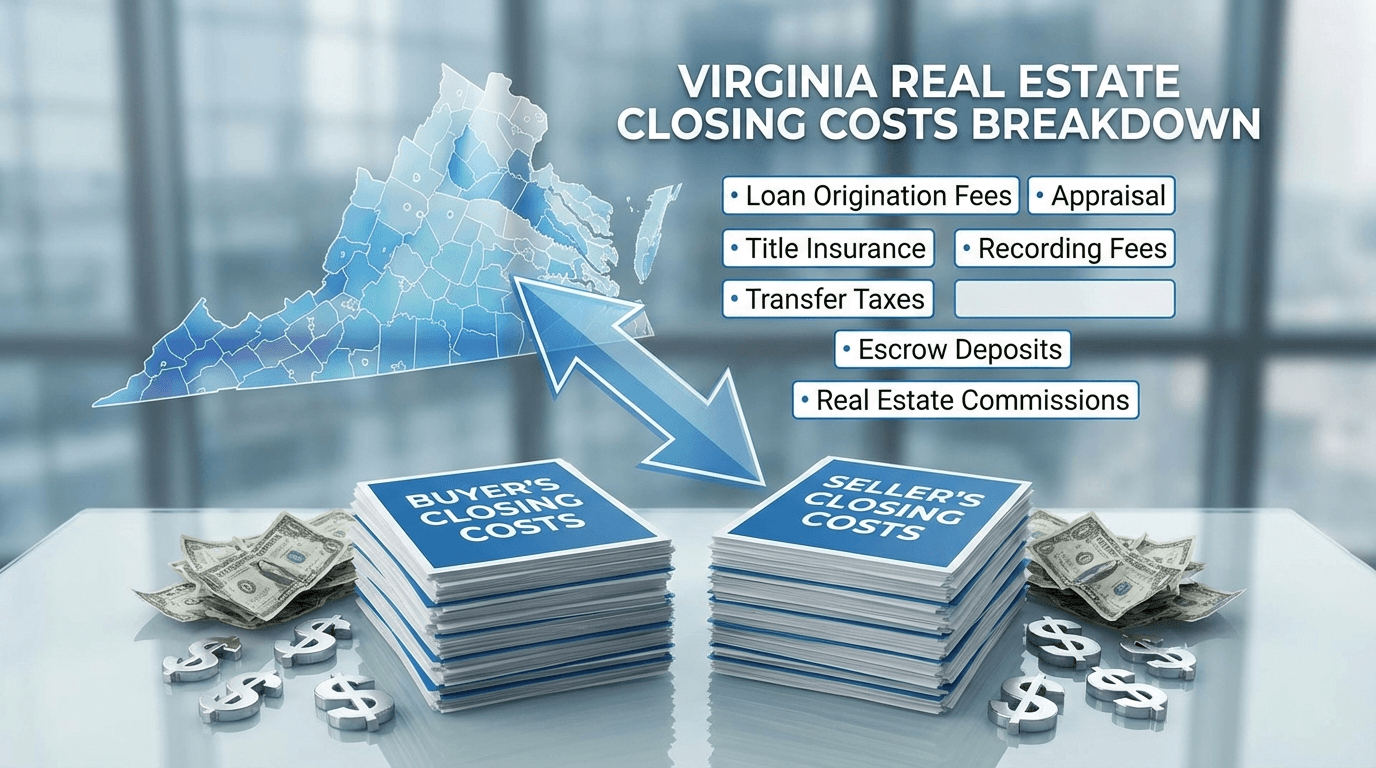

Key Takeaways
- A detailed breakdown of closing costs in Virginia for 2026 — what buyers pay, what sellers pay, and how to estimate your total costs before settlement day
You've negotiated the price. You've survived the inspection. The appraisal came back clean. Now you're staring at a closing disclosure with 30+ line items and a bottom-line number that's bigger than you expected.
Welcome to closing costs in Virginia.
Most buyers budget 2–5% of the purchase price for closing costs — but that range is so wide it's almost useless. Whether you're buying a $450K townhouse in Woodbridge or an $850K single-family in Vienna, the actual dollars vary significantly depending on your lender, your loan type, the county you're buying in, and the title company you choose.
This guide breaks down every major closing cost line item Virginia buyers and sellers face in 2026, with real dollar ranges from the DMV market.
What Are Closing Costs?
Closing costs are the fees and charges — beyond the purchase price — that buyers and sellers pay to complete a real estate transaction. They cover everything from the lender's underwriting work to the title search, insurance premiums, government recording fees, and the settlement agent's professional fee.
In Virginia, closing costs typically fall into four buckets:
- Lender fees — origination, underwriting, credit report, appraisal
- Title and settlement fees — title search, title insurance, settlement fee, escrow/closing
- Government fees — recording fees, transfer taxes, grantor's tax
- Prepaid items — homeowner's insurance, property taxes, HOA dues
Virginia Closing Costs for Buyers: Line by Line
Here's what a typical Virginia buyer pays at closing in 2026. These ranges reflect real transactions across Northern Virginia — Fairfax, Loudoun, Prince William, and Arlington counties.
Lender Fees
| Fee | Typical Range | Notes |
|---|---|---|
| Loan origination fee | 0.5–1% of loan | Some lenders roll this into rate |
| Underwriting fee | $400–$900 | Varies by lender |
| Appraisal fee | $450–$750 | Higher for jumbo or complex properties |
| Credit report fee | $30–$80 | Per borrower |
| Flood certification | $15–$25 | Required for all mortgage loans |
Title and Settlement Fees
| Fee | Typical Range | Notes |
|---|---|---|
| Title settlement fee | $450–$795 | The title company's professional fee |
| Title search / examination | $150–$400 | Researching the property's ownership chain |
| Lender's title insurance | $400–$1,200 | Required by your lender; based on loan amount |
| Owner's title insurance | $500–$1,500 | Optional but strongly recommended; based on purchase price |
| Title insurance endorsements | $50–$200 | Additional coverage riders |
Government Fees
| Fee | Typical Range | Notes |
|---|---|---|
| Recording fees | $40–$120 | Varies by county; deed + deed of trust |
| Grantor's tax | $1 per $1,000 of sale price | Seller typically pays in Virginia |
| Regional congestion tax (NoVA) | $0.15 per $100 of sale price | Applies in NoVA jurisdictions |
| Transfer tax | Varies | Some Virginia cities impose additional transfer taxes |
Prepaid Items
| Fee | Typical Range | Notes |
|---|---|---|
| Homeowner's insurance (first year) | $1,200–$3,000 | Depends on coverage, location, property age |
| Property tax escrow | 2–6 months prepaid | County rate × assessed value ÷ 12 |
| HOA transfer/disclosure package | $300–$600 | If applicable; paid by seller in many NoVA contracts |
| Prepaid interest | Varies | Per-diem interest from closing to month-end |
Virginia Closing Costs for Sellers
Virginia sellers have their own set of closing costs. Here's the breakdown:
| Fee | Typical Range | Notes |
|---|---|---|
| Real estate commission | 5–6% of sale price | Negotiable; split between listing and buyer agents |
| Grantor's tax | $1 per $1,000 | Seller's responsibility in Virginia |
| Congestion tax (NoVA) | $0.15 per $100 | Additional NoVA-specific tax |
| Deed preparation | $150–$350 | Attorney or title company drafts the deed |
| Payoff processing | $100–$300 | Your existing lender charges to process the mortgage payoff |
| HOA resale package | $300–$700 | Required disclosure documents; seller pays |
| Title company settlement fee | $200–$500 | Some contracts split this; seller's portion |
Real Example: Seller Closing Costs on a $650K Sale in Fairfax County
- Commission (5.5%): $35,750
- Grantor's tax: $650
- Congestion tax: $975
- Deed preparation: $250
- Payoff processing: $150
- HOA resale package: $475
- Settlement fee (seller side): $295
- Total seller costs: ~$38,545 (5.9% of sale price)
How Title Insurance Costs Work in Virginia
Title insurance is one of the most misunderstood closing costs. Here's what matters:
Lender's title insurance is required on any mortgage transaction. The premium is based on the loan amount and protects only the lender's interest.
Owner's title insurance is optional but covers you — the buyer — against title defects that surface after closing. In Virginia, the premium is based on the purchase price and is a one-time fee.
The simultaneous issue discount: When you buy both lender's and owner's policies from the same title company at the same time (which you almost always do), you get a significant discount — typically 30–40% off the combined premiums compared to buying them separately.
Virginia is a "file and use" state for title insurance rates, meaning insurers file their rates with the State Corporation Commission. Rates vary by underwriter, but they're generally competitive across the DMV.
How Closing Costs Differ Across the DMV
Virginia vs. Maryland
Maryland has a state transfer tax (0.5% of sale price) AND a county transfer tax (varies, typically 1–1.5%). This makes Maryland closings more expensive on the government fee side. Maryland also uses attorneys for closings in many counties, adding $500–$1,500 in legal fees.
Virginia vs. DC
DC has a recordation tax (1.1% for residential under $400K, 1.45% above) AND a transfer tax (1.1–1.45%). Buyers and sellers traditionally split these. DC closings are among the most expensive in the region for government-related fees.
Virginia Advantage
Virginia's closing cost structure is relatively buyer-friendly compared to Maryland and DC. No state transfer tax for buyers, lower recording fees, and no attorney requirement for closings.
How to Reduce Closing Costs in Virginia
-
Shop your title company. Settlement fees vary by $200–$400 across providers. Don't just accept whoever the agent recommends — get quotes from 2–3 title companies.
-
Negotiate seller credits. In a balanced market, you can often get the seller to contribute toward your closing costs — $5,000–$10,000 is common.
-
Compare lender fees. The loan estimate (LE) is standardized for a reason. Get LEs from 3+ lenders and compare origination charges, underwriting fees, and discount points.
-
Ask about the simultaneous issue discount. If your title company doesn't automatically apply it, ask. It saves hundreds on title insurance.
-
Check for lender credits. Some lenders offer credits toward closing costs in exchange for a slightly higher interest rate. Do the math on your break-even point.
Frequently Asked Questions
How much are closing costs in Virginia in 2026?
For buyers, expect 2–4% of the purchase price. On a $500,000 home, that's $10,000–$20,000. The exact amount depends on your loan type, lender, county, and title company.
Who pays closing costs in Virginia — buyer or seller?
Both pay closing costs, but different ones. Buyers pay lender fees, title insurance, and prepaids. Sellers pay commissions, grantor's tax, and deed preparation. Some fees (like the settlement fee) are negotiable.
Are closing costs negotiable in Virginia?
Many are. The real estate commission, seller credits, and title company fees are all negotiable. Lender fees vary by provider. Government fees and taxes are fixed.
What is the grantor's tax in Virginia?
$1 per $1,000 of the sale price. On a $500,000 sale, that's $500. In Northern Virginia, there's an additional congestion tax of $0.15 per $100 of the sale price ($750 on a $500K sale).
Can I roll closing costs into my mortgage in Virginia?
Some loan programs allow it (VA loans, USDA loans). Conventional and FHA loans generally don't allow rolling in closing costs, but you can negotiate seller credits or lender credits to offset them.
The Bottom Line
Virginia closing costs aren't a mystery — they're a math problem. Know the line items, compare providers, and negotiate where you can. The biggest variable most buyers overlook is the title company — and that's the one place where a 10-minute phone call can save you real money.
Need a closing cost estimate for your DMV transaction? Get a free quote →